← Back to the English home page
Vitamin C: what it does and how to use it
Published on November 2, 2026 · 5-minute read
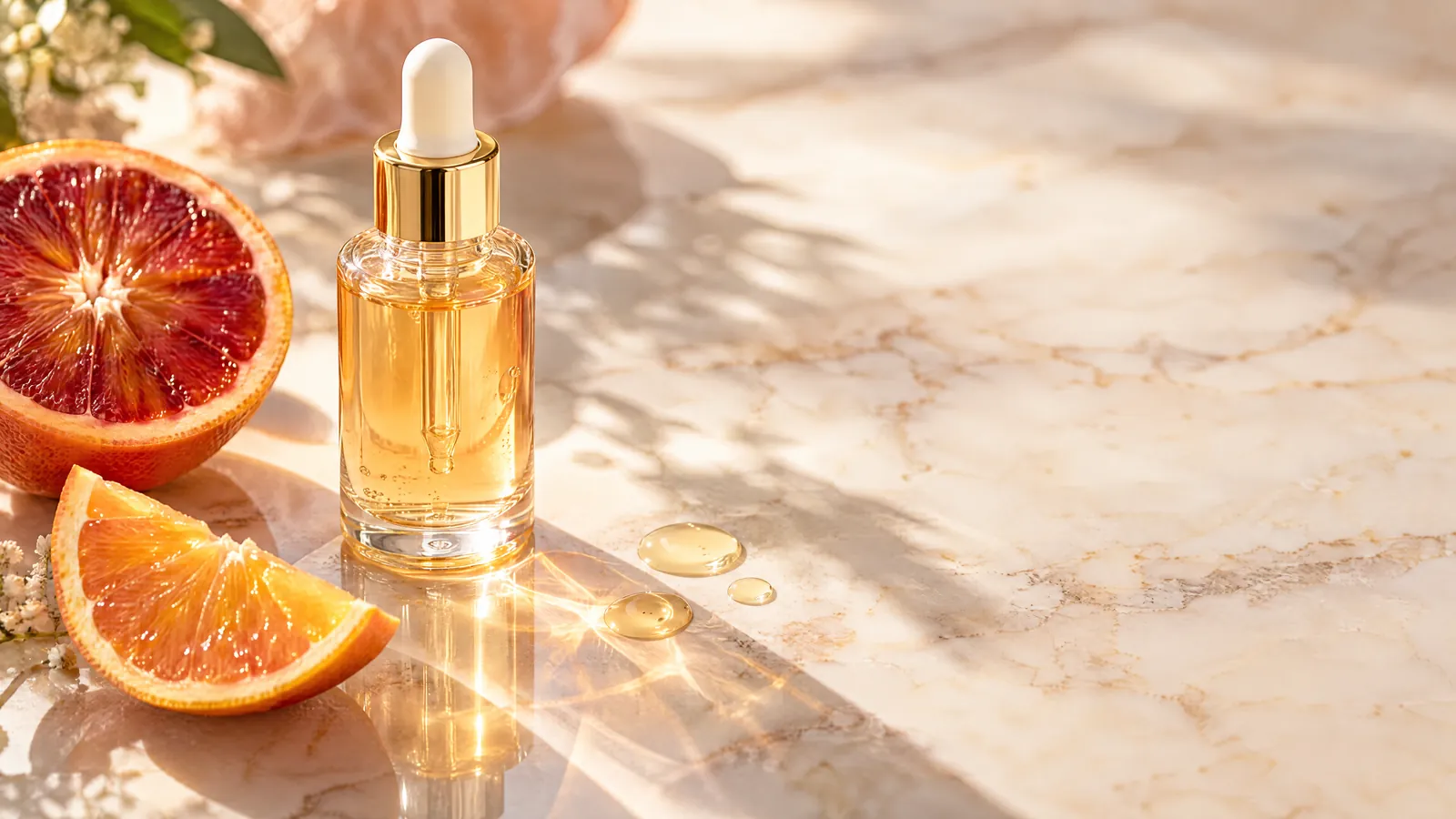
Vitamin C is one of the most popular skincare ingredients. It is an antioxidant, plays a part in collagen production and may help with dark spots (Badash et al., 2026). Clinical studies are still limited (Al-Niaimi et al., 2017), and using it the wrong way can waste the product (or even irritate your skin).
What vitamin C does
- Brightens the tone: helps make skin tone more even (Badash et al., 2026)
- Helps with dark spots: reduces melanin formation (Al-Niaimi et al., 2017). In melasma, a trial with 5% vitamin C lightened less than hydroquinone, but with almost no side effects (Espinal-Perez et al., 2004)
- Antioxidant: helps protect the skin from environmental damage, especially from the sun (Badash et al., 2026)
- Complements sunscreen: it works through a different pathway from UV filters, but does not replace SPF (Murray et al., 2008)
- Supports collagen: increases production and reduces breakdown, which may soften fine lines (Al-Niaimi et al., 2017)
When to use it: preferably in the morning
Most people use it in the morning, because it:
- Protects against the day's free radicals
- Adds to the protection of sunscreen (Murray et al., 2008)
But using it at night is not a waste. In a study on pig skin, vitamin C stayed in the skin for days after application (Pinnell et al., 2001), and a melasma trial used the product at night (Espinal-Perez et al., 2004).
Ideal concentration
| Concentration | For whom | What we know |
|---|---|---|
| 5-10% | Beginners, sensitive skin | Milder. In the 5% trial, there were almost no side effects (Espinal-Perez et al., 2004) |
| 10-15% | Most people | A common range. A study in people used 15%, together with vitamin E and ferulic acid (Murray et al., 2008) |
| 15-20% | Experienced users | In pig skin, 20% was the concentration with the best absorption (Pinnell et al., 2001) |
| Above 20% | — | In the same study, it did not increase absorption |
How to use it (step by step)
- Cleanse your face
- Apply vitamin C to dry skin (3-5 drops)
- Wait 1-2 minutes for it to absorb
- Apply moisturizer
- Finish with sunscreen (a must!)
Combinations that work
| Combination | Result |
|---|---|
| Vitamin C + sunscreen | ✅ Each complements the other (Murray et al., 2008) |
| Vitamin C + vitamin E | ✅ They work together against oxidation (Al-Niaimi et al., 2017) |
| Vitamin C + ferulic acid | ✅ A more stable formula; with vitamin E, it protected the skin against UV damage in a study in people (Murray et al., 2008) |
| Vitamin C + niacinamide | ⚠️ Studies on the pair are lacking; if it stings, use them at different times of day |
| Vitamin C + retinol | ⚠️ Together they may irritate more; the simplest approach is vitamin C in the morning and retinol at night |
Recommended products
These products are sold in Brazil, where this site is based. Approximate prices in Brazilian reais (BRL).
- Principia VC-10: 10%, best value (R$ ~50)
- Creamy Vitamina C 10%: Brazilian brand, easy to find (R$ ~70)
- Mantecorp Ivy C Ferulic: with ferulic acid (R$ ~90)
Take the skin quiz (in Portuguese) →
Sources
- Badash A, et al. Vitamins and the skin: Vitamin C in dermatology. Clin Dermatol, 2026. PubMed 41690651 · DOI
- Al-Niaimi F, et al. Topical Vitamin C and the Skin: Mechanisms of Action and Clinical Applications. J Clin Aesthet Dermatol, 2017. PubMed 29104718
- Espinal-Perez LE, et al. A double-blind randomized trial of 5% ascorbic acid vs. 4% hydroquinone in melasma. Int J Dermatol, 2004. PubMed 15304189 · DOI
- Murray JC, et al. A topical antioxidant solution containing vitamins C and E stabilized by ferulic acid provides protection for human skin against damage caused by ultraviolet irradiation. J Am Acad Dermatol, 2008. PubMed 18603326 · DOI
- Pinnell SR, et al. Topical L-ascorbic acid: percutaneous absorption studies. Dermatol Surg, 2001. PubMed 11207686 · DOI
References checked on PubMed in November 2026. Claims about effectiveness are based on the abstracts of these studies.
Translated from the Portuguese original. Contains affiliate links. This text has not yet been reviewed by a dermatologist. © 2026 Produto Skincare.